Recovering a Failing System With V-LIFE: Kangean Gas Field
May 19, 2017
This case study is an edited version of a paper written by Martin Ongkosutjahjo, Aries Bambang S, Darmansyah and Ahmad Bunyamin, which was presented at the Indonesian Petroleum Association Conference. 17-19 May, 2017 – Jakarta. The edits have been undertaken in order to present the contents in a suitable format for use as a case study.
Insulation Remedial System Solution: for low insulation resistance problem on the subsea electrical failure TSB control system.
This paper describes the method of reviving the conductivity property of electrical and communication lines which have deteriorated due to low insulation resistance caused by water ingress by means of introducing V-LIFE to the failing electrical and communication lines. This method was applied to the failing power and communication lines of the subsea control system at Kangean’s Terang Sirasun Batur (TSB) gas field. The result indicates that this method of introducing the V-LIFE process increases the low insulation resistance value back to the acceptable range of operating value.
Introduction
Subsea control system typically consists of electrical (electrical current to power the subsea instrumentations and to operate the valves), hydraulic, and communication lines.
To prevent contact between the conducting elements themselves or between conducting elements and seawater or commonly termed water ingress, the conducting elements must be sufficiently insulated. The insulation must typically have a minimum insulation resistance value for it to sufficiently insulate the conducting elements. They are typically in the range of 10 megaohms and above. An alarm and system shutdown (trip) would be typically set to the value below 800 kiloohms.
Below this limit, the electrical and communication lines fail to function which means a total loss of control of subsea equipment and instrumentation readings. In this particular case presented in this paper, it was established that the drop in insulation resistance value of the power and communication lines were caused by water ingress.

The conventional method to rectify this problem is to replace the component that is exposed to the seawater. Replacing a subsea component involves meticulous planning which requires many long lead activities such as the procurement of the component itself and obtaining vessels with the qualified personnel capable of carrying out the replacement activity. Subsea intervention would undoubtedly have an effect on the day-to-day operational activity and hydrocarbon production.
Electrochemical process method allows a rectification activity to this problem without the need of subsea intervention and minimal effect on the day-to-day operation activity. Identification of the exact location or component that is exposed to seawater is also not required.
This paper shall describe the use of V-LIFE as a solution to revive the low insulation resistance
and the general electrical configuration of the equipment promoting the electrochemical process, and the advantage of this recently invented method over the conventional method of rectifying low insulation resistance.
Insulation monitoring standards:
IEC 61557-1: 2007
IEC 61557-8: 2014
Notice: Product complies with Part 15 of the FCC rules, subject to the following two conditions: 1. The device may not cause harmful interference. 2. This device must accept any interference received, including interference that may cause undesired operation.
Electrochemical process
The electrochemical process by definition is any process either caused or accompanied by the passage of an electric current and involves in most cases the transfer of electrons between two substances – one a solid and the other a liquid.
In the particular case of rejuvenation of subsea electrical line, the electrochemical process shall involve an electrical conductor element and seawater. The process results in the formation of a barrier element.
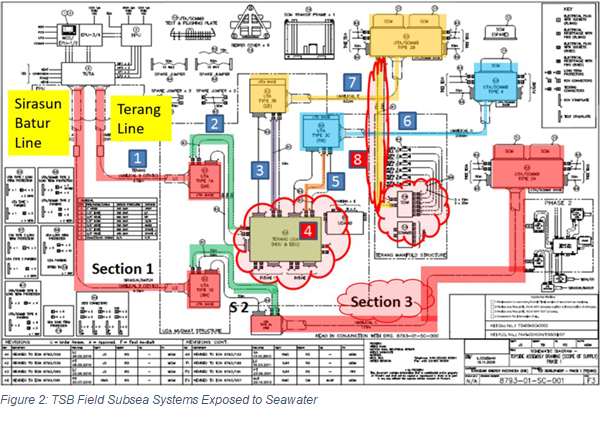
This V-LIFE process takes place on the section of the subsea control system shown in figure 1 below (Clouded section) i.e. the section that is exposed to seawater.
Reviving the low insulation resistance of electrical line
a. The principle
The V-LIFE signal is selected as such that in when an electrical current flowing between the conducting element and seawater an electrokinetic and electrochemical reaction is triggered resulting in the formation of a barrier element restricting the current leakage flow thus improving the insulation resistance of the cable.
b. Subsea control system configuration
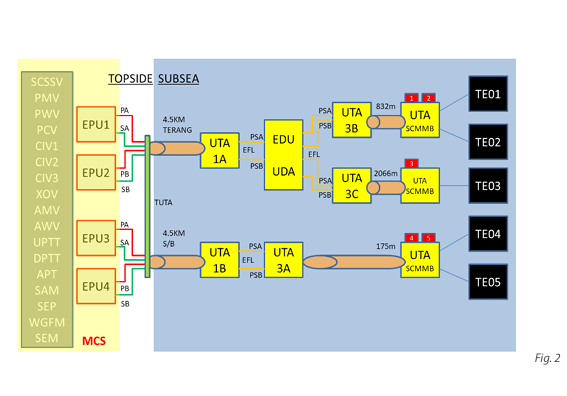
Figure 2 below shows the configuration of a typical Topside-Subsea control system.
c. Electrical configuration
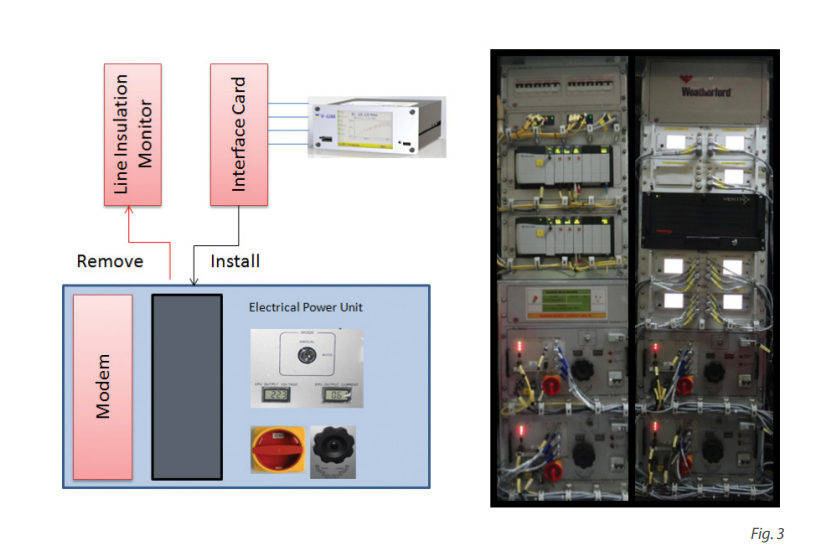
The Insulation Remedial equipment is connected to the topside control system with the configuration shown in figure 3 below.
It must be noted that the formation of the barrier element, being directly in contact with the seawater, can dissolve over time or be wasted away. This results in an increase of current leakage which in turn promoting the generation of new barrier element replacing the eroded earlier formation.
The continuous supply of the V-LIFE signal from the topside will perpetually maintain this process cycle. Thus this process is a self-maintaining process.
Results
The following figures are the recorded value of the insulation resistance of the subsea control system before and after the application of the V-LIFE signal to promote the barrier formation at the part of the electrical line that is exposed to seawater. It is evident that the barrier generated by the V-LIFE process immediately took place by the sharp increase of the insulation resistance over a short period of time.
It can also be seen that during the recovery period the insulation resistance improved dramatically and then dropped again shortly after albeit not to the critical level. This fluctuation was expected as it was part of the recovery process before the insulation resistance finally reached a steady level
onward.
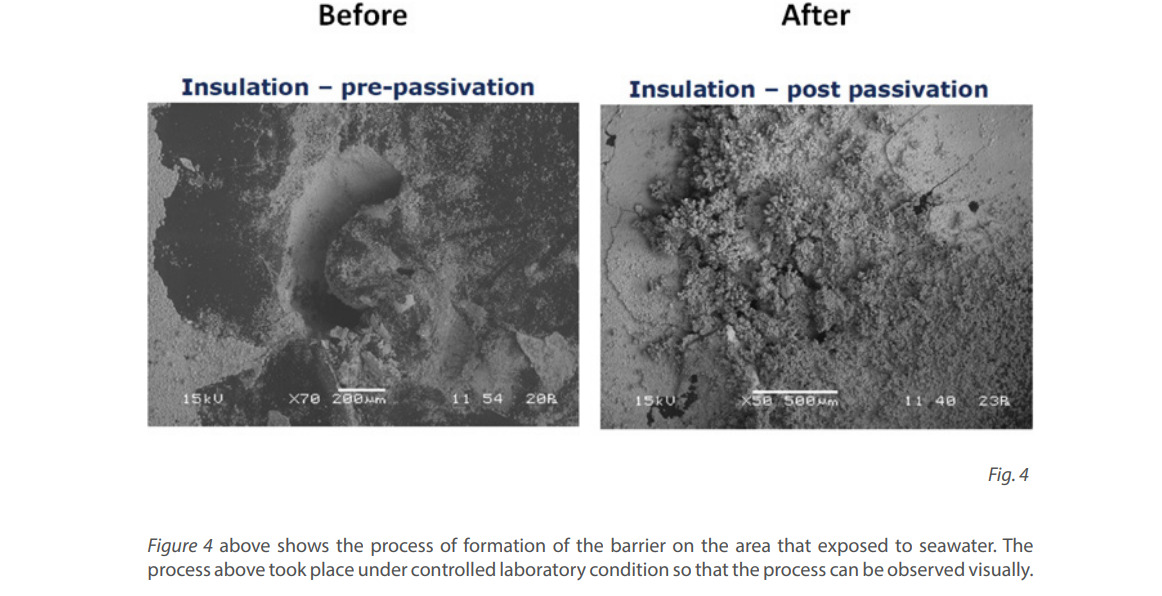
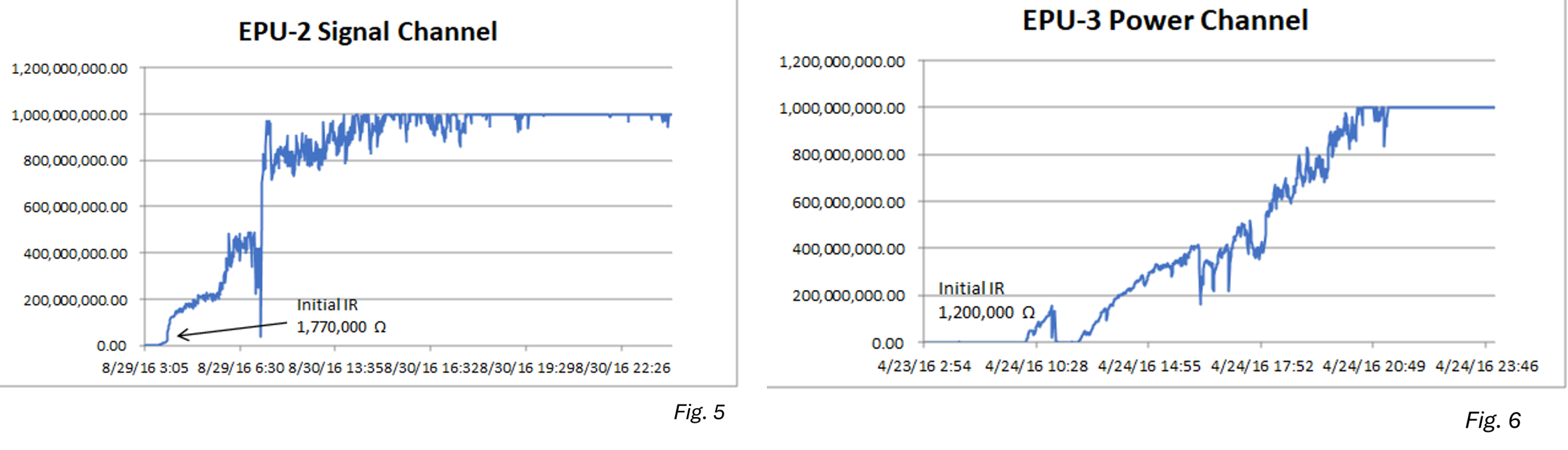
Figure.5, Figure.6, and Figure.7 above show the improvement of insulation resistance on the electrical signal and power lines. It can be seen that the improvement on the lines also depends on the initial value of the insulation resistance. The lower the initial value the longer it takes for the proposed method to reach a steady operating value of insulation resistance.
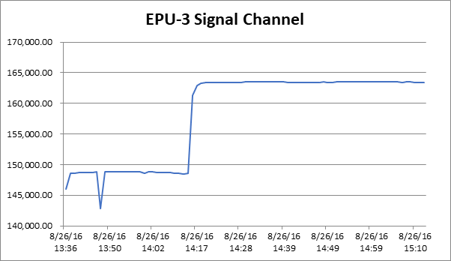
The following is an example where the insulation resistance was too low for the V-LIFE method to lift it to the acceptable operating value. The V-LIFE technique here is shown initially appeared to have improved the insulation resistance, but unable to improve it further and reached its maximum value after a period of time.
To have the subsea control system functioning at all time is vital, thus when there is a sudden loss of power and communication to the subsea equipment and instrumentations it is critical to have a decision made immediately and action is taken to have the faulty lines rectified.
Things to be considered when taking a decision on rectification action typically involves technical complexity, cost, time, resources, remaining hydrocarbon production, insurances, importation formalities if there is the need to bring in equipment from abroad, the size or dimension of the equipment, etc. This is where the proposed method comes on top and shows its advantages over the conventional method. The proposed method has the advantages of being a hand-carried size in terms of dimension, it does not require a specific procedure to transport, it can be immediately mobilised, and most importantly it is cost effective.
Even though the proposed method has been shown to improve the insulation resistance in several cases it has limitations. V-LIFE is unable to guarantee a revival of a low insulation resistance value when the value is below 30 kOhm, to begin with.